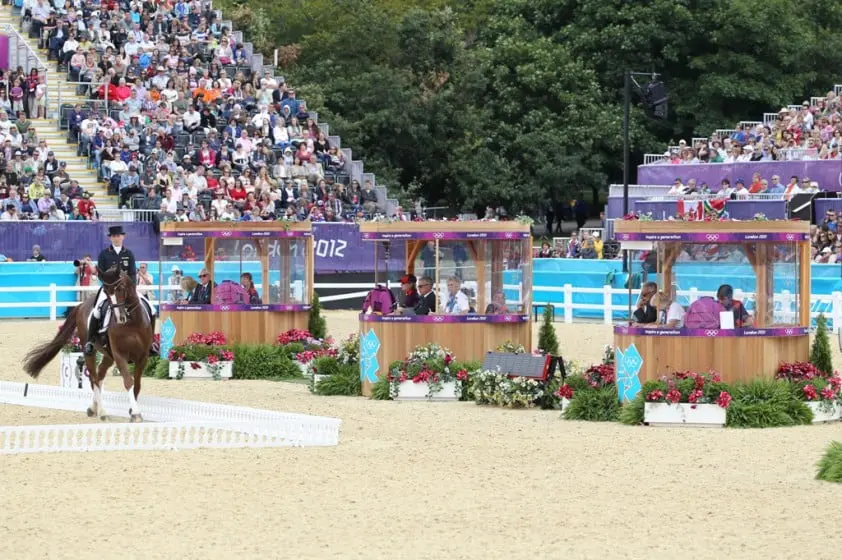
Dressuur-directeur Trond Asmyr van de FEI kondigde vandaag bij zijn presentatie aan het begin van het Global Dressage Forum een verbod op moderne communicatiemiddelen zoals mobiele telefoons, smartphones en iPads in het juryhokje af. Het schijnt voor te komen dat juryleden tijdens de wedstrijd via het internet informatie verzamelen. "Dat is vanaf nu afgelopen", aldus Asmyr.
Ook is het vanaf nu verboden dat juryleden tijdens de wedstrijd zicht hebben op een scorebord, waarop zij de cijfers van collega’s kunnen zien.
Bron: Horses
Als de FEI nu nog een stap verder gaat en de juryleden verplicht weer volgens de FEI regels en niet naar naam, mode en/of smaak te beoordelen, gaan de paardensport, de schoonheid van de dressuur en het welzijn van de paarden er met sprongen op vooruit. De dressuur wordt dan weer RIJKUNST. Het is voorts te hopen dat ook het hippische journaille op dit terrein beter de vinger aan de pols houdt.
FEI (Fédération Equestre Internationale)
Article 401 – Object and general principles
1. The object of Dressage is the development of the horse into a happy athlete through harmonious education. As a result it makes the horse calm, supple, loose and flexible, but also confident, attentive and keen, thus achieving perfect understanding with his rider.
2. These qualities are revealed by:
2.1. The freedom and regularity of the paces;
2.2. The harmony, lightness and ease of the movements;
2.3. The lightness of the forehand and the engagement of the hind quarters, originating in a lively impulsion;
2.4. The acceptance of the bridle, with submissiveness throughout and without any tenseness or resistance.
3. The horse thus gives the impression of doing of his own accord what is required of him. Confident and attentive, he submits generously to the control of his rider, remaining absolutely straight in any movement on a straight line and bending accordingly when moving on curved lines.
4. His walk is regular, free and unconstrained. His trot is free, supple, regular, sustained and active. His canter is united, light and cadenced. His quarters are never inactive or sluggish. He responds to the slightest indication of the rider and thereby gives life and spirit to all the rest of his body.
5. By virtue of a lively impulsion and the suppleness of his joints, free from the paralysing effects of resistance, the horse obeys willingly and without hesitation and responds to the various aids calmly and with precision, displaying a natural and harmonious balance both physically and mentally.
6. In all his work, even at the halt, the horse must be “on the bit”. A horse is said to be “on the bit” when the neck is more or less raised and arched according to the stage of training and the extension or collection of the pace, and he accepts the bridle with a light and soft
contact and submissiveness throughout. The head should remain in a steady position, as a rule slightly in front of the vertical, with a supple poll as the highest point of the neck, and no resistance should be offered to the rider.
7. Cadence is shown in trot and is the result of the proper harmony that a horse shows when it moves with well marked regularity, impulsion and balance. Cadence must be maintained in all the different trot exercises and in all the variations of trot.
8. The rhythm that a horse maintains in all his paces is fundamental to Dressage.